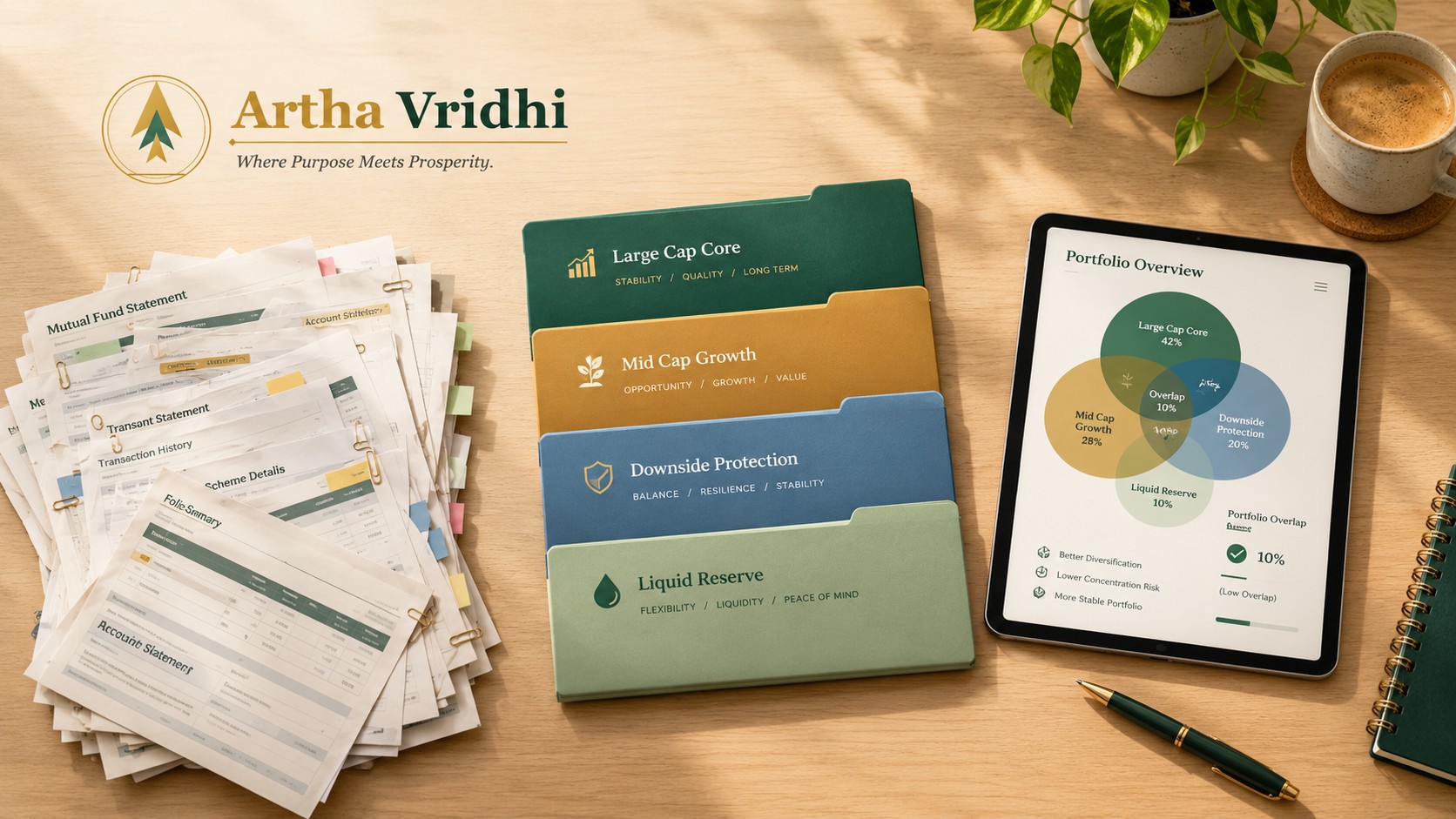
Is Your MF Portfolio Overcrowded? How SEBI’s Overlap Norms Can Clean Up Your Investments
In the era of one-click mutual fund investing via mobile apps, building a mutual fund portfolio has never been easier. Unfortunately, accumulating mutual funds has become just as easy as ordering takeout on a Friday evening.
A retail investor starts with a Nifty 50 Index fund. A few months later, a social media influencer praises a top-rated Flexi-Cap fund, so they add a second SIP. Next, a friend recommends a Large & Mid-Cap fund; an online portal highlights a trending Multi-Cap fund; and a festive market report touts an infrastructure thematic fund.
Before they know it, a 30-year-old salaried professional is running 12 to 15 different mutual fund SIPs of ₹2,000 to ₹5,000 each.
They believe they are masterfully diversified. In reality, they have fallen into the classic trap of diworsification.
In this guide, we explore why having too many mutual funds destroys investment alpha, examine the regulatory thrust behind SEBI’s 50% scheme overlap restrictions, and provide a 4-step framework to prune your holdings down to a high-conviction, minimalist portfolio.
The Illusion of Diversification: What Is Portfolio Overlap?
Diversification means spreading your risk across truly independent assets. But when you buy multiple mutual funds within the same broad equity universe, an unexpected phenomenon occurs: they all buy the exact same underlying companies.
If you examine the fact sheets of three prominent Indian mutual funds—say, a Large-Cap Fund, a Flexi-Cap Fund, and a Focused Equity Fund—you will almost certainly find the same top 10 heavyweights dominating their portfolios:
- HDFC Bank
- Reliance Industries
- ICICI Bank
- Infosys
- Tata Consultancy Services (TCS)
- ITC Limited
- Larsen & Toubro
If 55% to 70% of your money across four different schemes is invested in the identical basket of 15 blue-chip stocks, you do not have four distinct investments. You have purchased the same basket four times, paying separate active management expense ratios (Total Expense Ratio / TER) on each one.
You have constructed a closet Nifty 50 Index fund—at three times the cost.
Understanding SEBI’s Overlap & Rationalization Directives
Recognizing this widespread retail confusion, the Securities and Exchange Board of India (SEBI) has steadily tightened mutual fund categorization and portfolio disclosure norms.
Key regulatory focus areas include:
- The 50% Portfolio Overlap Ceiling: SEBI’s guidelines enforce strict differentiation mandates. In categories like sectoral, thematic, value, and contra funds, asset management companies (AMCs) must ensure that portfolio overlap does not exceed 50% across their distinct scheme offerings.
- Introduction of Target-Maturity Life Cycle Funds: SEBI’s evolving framework encourages lifecycle solutions with predetermined glide paths, automatically shifting asset allocation from equity to debt as an investor approaches retirement, eliminating the need for investors to manually juggle dozens of fragmented funds.
- Fortnightly & Monthly Portfolio Disclosures: Mutual fund houses are mandated to release granular portfolio holdings twice a month, empowering investors and distributors to scrutinize exact stock holdings and detect portfolio creep.
The True Costs of an Overcrowded Portfolio
Why is holding 12+ mutual funds detrimental to your financial health?
| Metric | The Overcrowded Portfolio (12–15 Funds) | The Minimalist Core Portfolio (3–4 Funds) |
|---|---|---|
| Overlap Ratio | High (50% – 70% common stock holdings) | Low (<25% overlap across asset segments) |
| Blended TER (Cost) | 0.90% – 1.60% (Multiple active fund fees) | 0.40% – 0.75% (Mix of low-cost passive & active) |
| Tracking & Monitoring | Nightmare (Dozens of statements & CAS pages) | Simple (10-minute quarterly health check) |
| Capital Gains Filing | Complex (Dozens of small redemption transactions) | Streamlined (Clean, consolidated tax reporting) |
| Risk of Diworsification | Severe (Winners get diluted by mediocre laggards) | Minimal (High-conviction exposure across market caps) |
The 4-Step Portfolio Clean-Up Framework
Ready to declutter your portfolio? Follow this systematic 4-step pruning process:
1. Download Your Unified CAS Statement
Visit the official websites of CAMS (camsonline.com) or KFintech (kfintech.com) and request a consolidated, detailed Consolidated Account Statement (CAS) using your PAN. This document lists every single mutual fund folio, unit balance, and current valuation registered under your name across all Indian fund houses.
2. Run a Portfolio Overlap Audit
Use a trusted portfolio tracking tool, distributor terminal, or free mutual fund overlap calculator. Pair your funds two by two (e.g., Fund A vs. Fund B).
- If the overlap is under 30%, the funds are genuinely complementary.
- If the overlap is between 30% and 50%, evaluate whether both are necessary.
- If the overlap is above 50%, you are holding duplicate mandates. Select the fund with the superior risk-adjusted track record (higher Sharpe ratio, consistent downside protection) and lower expense ratio, and mark the other for consolidation.
3. Transition to the ‘Core 4’ Portfolio Blueprint
For 90% of Indian salaried and retail investors, an entire equity wealth engine can be powered by just 3 to 4 well-chosen funds:
- The Compounding Anchor (35%–40%): A Nifty 50 Index Fund or a high-conviction Flexi-Cap Fund providing steady large-cap governance and stability.
- The Growth Accelerator (25%–30%): A Mid-Cap or Large & Mid-Cap Fund capitalizing on India’s mid-sized champions and manufacturing themes.
- The Tactical Diversifier (20%–25%): A Balanced Advantage Fund or Multi-Asset Allocation Fund providing built-in downside shock absorption.
- The Satellite / Small-Cap Sleeve (10%–15%): A focused Small-Cap Fund for investors with a 7+ year horizon seeking high long-term alpha.
4. Execute a Tax-Smart Phased Exit
Do not panic and redeem all your extra funds in a single afternoon, as this could trigger Short-Term Capital Gains (STCG) tax.
- Stop fresh SIPs immediately in the redundant or underperforming funds. Redirect those monthly amounts into your chosen Core funds.
- Allow existing units in the legacy funds to mature until they cross the 12-month threshold to qualify for Long-Term Capital Gains (LTCG) tax benefits.
- Systematically redeem the legacy units gradually, taking full advantage of the annual ₹1.25 Lakh exemption on long-term equity capital gains.
Frequently Asked Questions
Will closing old mutual fund folios harm my CIBIL credit score?
No. Mutual funds are investment assets, not debt or credit lines. Redeeming or closing mutual fund folios has zero impact on your CIBIL credit score.
Is it better to hold Direct plans or Regular plans?
Direct plans bypass distributor commissions and have lower expense ratios, which mathematically compounds to higher returns over decades. However, if you are a busy professional who lacks the time, knowledge, or discipline to rebalance, manage tax implications, and avoid emotional panic during market downturns, working with an AMFI-registered Mutual Fund Distributor (MFD) can provide behavioral coaching that easily offsets the fee differential.
How often should I re-evaluate my mutual fund portfolio?
An annual review (once every 12 months) is optimal. Avoid reviewing weekly or monthly NAV movements, as short-term noise causes unnecessary anxiety and tempts you into over-trading.
Talk to Artha Vridhi
Artha Vridhi helps salaried professionals in Bengaluru audit messy portfolios, eliminate costly fund overlap, and build streamlined, goal-oriented investment blueprints. If your mutual fund list has grown out of control and you want a clean, professional portfolio review, connect with us on WhatsApp or visit www.arthavridhi.com.
Artha Vridhi · Where Purpose Meets Prosperity.
Saikat Rakshit, AMFI-registered Mutual Fund Distributor (ARN-362803), Bengaluru.
This article is for educational purposes only and is not investment advice. Scheme categories and regulatory circulars appear for informational reference. Past performance does not guarantee future results.
Mutual fund investments are subject to market risks. Please read all scheme-related documents carefully before investing.