
Life Cycle Mutual Funds in India: How Glide Paths Work & Who They Are Truly For
Managing long-term wealth requires answering a question that makes even seasoned investors pause: at what exact moment should you begin moving your hard-earned gains out of equities and into capital-preserving fixed income?
Shift too early, and your corpus loses purchasing power against persistent inflation. Shift too late, and an ill-timed market crash right before your planned goal-such as retirement or a child’s higher education-can erase years of compounding in a matter of weeks.
In mature financial ecosystems like the United States, target-date retirement funds hold trillions of dollars in assets because they eliminate this guesswork. Under updated regulatory guidelines issued by the Securities and Exchange Board of India (SEBI), Life Cycle Funds are officially establishing themselves within the Indian mutual fund landscape.
At the center of every life cycle fund is an automated investment mechanism known as a glide path. In this guide, we break down how glide paths work, the regulatory framework governing Indian lifecycle funds, the key benefits and structural limitations, and how salaried retail investors can evaluate whether an automated lifecycle fund fits their financial goals.
What Is a Life Cycle Mutual Fund?
A Life Cycle Fund (often categorized globally as a Target-Date Fund or TDF) is an open-ended hybrid fund structured around a designated target year or maturity horizon. Unlike traditional mutual funds where the investment mandate remains static-such as an equity fund perpetually maintaining 80% to 100% in stocks, or a conservative hybrid fund holding 75% in bonds-a life cycle fund is designed with a dynamic lifecycle.
When you enter a life cycle fund designed for a distant milestone-say, 15 or 20 years away-the fund begins with an aggressive, growth-oriented allocation dominated by equities. As the calendar moves closer to the fund’s maturity date, the fund manager systematically reduces equity exposure and reallocates capital into sovereign bonds, corporate debt, and money market instruments.
The investor does not have to execute switches, monitor portfolio drift, or make subjective market-timing calls. The fund manages the de-risking process internally.
Deconstructing the Glide Path: The Engine Behind Lifecycle Investing
The term glide path is borrowed from aviation, where an aircraft follows a calculated descent profile to touch down smoothly on the runway. In asset management, the glide path represents the mathematical formula or predetermined schedule that dictates how asset allocation shifts across the investment horizon.
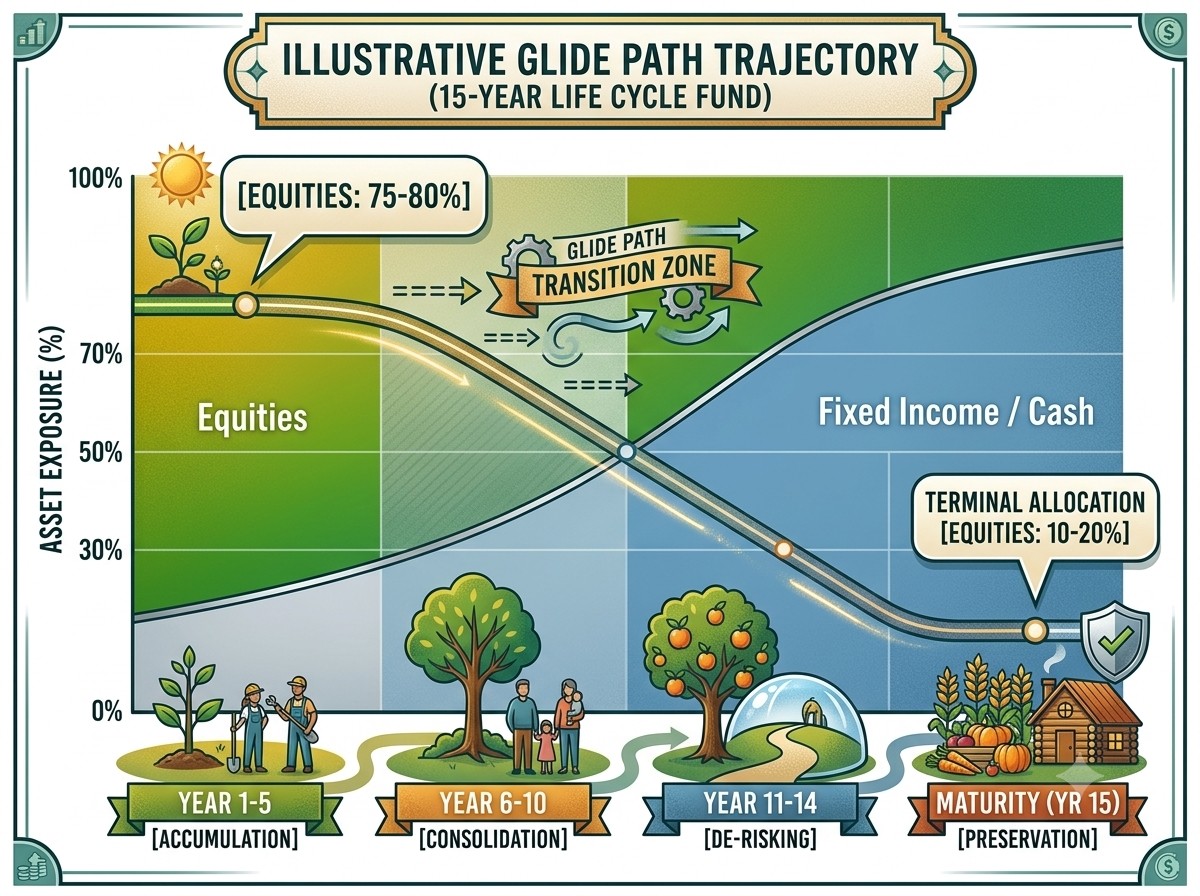
The Three Operational Stages of a Glide Path
-
The Accumulation Phase (Long Runway: 10+ Years to Goal):
- Equity Exposure: 65% to 85%
- Debt & Money Market: 15% to 25%
- Alternative Assets (Gold/Commodities): Up to 10%
- Strategic Rationale: With a multi-year horizon, the investor’s greatest risk is not short-term market volatility; it is inflation risk. Equities provide the compounding power required to outpace consumer inflation and generate real alpha.
-
The Consolidation Phase (Transition Runway: 3 to 7 Years to Goal):
- Equity Exposure: 35% to 50%
- Debt & Money Market: 35% to 50%
- Strategic Rationale: At this stage, capital preservation begins to take equal priority alongside wealth generation. The fund locks in accumulated equity gains by rebalancing systematically into high-grade fixed income instruments, protecting against sudden cyclical downturns.
-
The Preservation Phase (Final Landing: Under 3 Years to Goal):
- Equity Exposure: 5% to 20%
- Debt & Sovereign G-Secs: 65% to 80%
- Cash Equivalents: 10% to 15%
- Strategic Rationale: With the finish line in sight, sequence-of-returns risk peaks. The fund minimizes equity volatility to ensure the accumulated corpus is liquid and protected from broad market drawdowns when the investor needs to redeem.
SEBI Framework for Life Cycle Funds in India
Under SEBI’s regulatory guidelines, mutual fund schemes within the lifecycle and solution-oriented categories must adhere to transparent, pre-disclosed asset allocation ranges.
| Parameter | Regulatory Mandate / Industry Practice |
|---|---|
| Structure | Open-ended scheme with a predefined maturity horizon or target year |
| Underlying Assets | Domestic equities (often large- and mid-cap indices), Indian Sovereign G-Secs, high-grade corporate bonds (AA and above), and gold/silver ETFs |
| Asset Allocation Disclosure | Explicitly stated in the Scheme Information Document (SID) and Key Information Memorandum (KIM) |
| Rebalancing Frequency | Automated, formulaic shifts executed periodically (e.g., quarterly or annually) |
| Exit Load Structure | Typically structured with a declining exit load (e.g., 3% in year 1, 2% in year 2, 1% in year 3, 0% thereafter) to discourage short-term trading |
By enshrining the glide path inside the SID, fund houses ensure that the fund manager cannot make arbitrary, discretionary allocation bets. The portfolio’s de-risking trajectory remains predictable from day one.
Comparison: Life Cycle Funds vs. Traditional Investment Vehicles
To understand where lifecycle funds fit into your broader asset allocation, consider how they stack up against other popular multi-asset and retirement instruments in India:
| Feature | Life Cycle Funds | Balanced Advantage Funds (BAFs) | Multi-Asset Allocation Funds | Traditional DIY Equity SIPs |
|---|---|---|---|---|
| Primary Allocation Trigger | Time Remaining to Goal | Market Valuations (P/E, P/B, Momentum) | Fixed Asset Band Mandate | Manual Investor Decisions |
| Rebalancing Mechanism | Automated via Glide Path | Dynamic / Algorithmic | Internal Fund Rebalancing | Manual Switching / Redemption |
| Horizon Orientation | Defined Target Date (e.g., 2035, 2041) | Perpetual / All-Weather | Perpetual / Medium-to-Long Term | Flexible / Discretionary |
| Terminal Asset Mix | Highly Conservative (Debt-heavy) | Dynamic (Varies with market) | Balanced across Equities, Debt, Commodities | Unchanged unless manually altered |
| Discretionary Flexibility | Low (Bound by Scheme Glide Path) | Moderate to High (Fund Manager Discretion) | Moderate | High (Complete Investor Control) |
Where Automated Life Cycle Funds Fall Short: The Need for Goal-Mapped Planning
While lifecycle funds offer a commendable “set-it-and-forget-it” framework, they are standardized, off-the-shelf financial products. They operate on a fundamental assumption: all investors with a 2035 or 2045 target share identical risk profiles, tax brackets, and external balance sheets.
In practice, a salaried retail investor’s financial reality is significantly more nuanced:
1. Inability to Factor in External Fixed-Income Assets
For most salaried employees in India, a sizable portion of monthly savings flows automatically into mandatory retirement accounts like the Employee Provident Fund (EPF), Voluntary Provident Fund (VPF), Public Provident Fund (PPF), or National Pension System (NPS).
If an investor with a healthy EPF accumulation allocates their remaining liquid savings into a lifecycle fund that glides into 70% debt as retirement nears, their total household balance sheet becomes drastically over-weighted toward fixed income. This dilutes long-term compounding and leaves the portfolio exposed to real-terms inflation risk.
2. Rigid Timelines That Do Not Accommodate Career Pivots
What happens if you decide to take a sabbatical, launch an entrepreneurial venture, or opt for early financial independence (FIRE) five years ahead of schedule? Standard lifecycle funds cannot accelerate or decelerate their internal glide path to match your revised timeline.
3. The Artha Vridhi Perspective: Goal-Mapped Planning
At Artha Vridhi, we believe that wealth creation begins with purpose rather than product. Through our Goal-Mapped SIP Design, we help salaried professionals build personalized glide paths that consider the investor’s entire balance sheet-including existing EPF, NPS, real estate, and emergency reserves.
Rather than forcing your family’s future into a one-size-fits-all target fund, a customized goal-mapped plan allows you to:
- Align dedicated SIPs with distinct milestones (e.g., home purchase in 6 years, higher education in 12 years, retirement in 20 years).
- Maintain optimal equity compounding without unintended debt duplication.
- Utilize automated step-ups as career compensation expands over time.
Step-by-Step Evaluation: Is a Life Cycle Fund Right for You?
If you are considering adding a life cycle fund to your portfolio, run through this four-step decision framework:
- Confirm Your Horizon Matches the Fund’s Target Date: Ensure that your targeted milestone aligns closely with the scheme’s maturity year (within a 1- to 2-year window). Never invest in a 2041 fund if you anticipate needing the capital by 2032.
- Review Your Aggregate Debt Exposure: Calculate your ongoing contributions to EPF, PPF, and fixed deposits. If fixed income already constitutes more than 40% of your net worth, an aggressive multi-cap or flexi-cap equity strategy paired with manual rebalancing may deliver superior outcomes.
- Examine the Scheme’s Underlying Assets: Verify whether the lifecycle fund utilizes passive low-cost index funds or active equity stock selection, and whether the debt portion focuses on sovereign G-Secs or credit-risk corporate debt.
- Account for the Exit Load Window: Ensure you will not need to liquidate units during the first 36 months, during which tiered exit loads are levied to enforce investment discipline.
Frequently Asked Questions (FAQ)
What happens to a life cycle fund once it reaches its maturity year?
Depending on the specific scheme provisions detailed in the SID, the fund may either liquidate and distribute the proceeds directly to unit-holders, merge into an existing liquid or conservative hybrid fund, or continue operating as an open-ended conservative income fund with minimal equity exposure.
Are life cycle mutual funds risk-free?
No. Life cycle funds are market-linked instruments. During the initial growth phase, they carry significant equity market risk and volatility. During the preservation phase, while equity risk is substantially reduced, the portfolio remains exposed to interest rate fluctuations and inflation risk.
How are capital gains taxed in Indian life cycle funds?
Taxation depends on the fund’s average gross equity exposure over the holding period:
- Equity-Oriented Classification (Average Equity ≥ 65%): Long-Term Capital Gains (LTCG) realized after 12 months are taxed at 12.5% on gains exceeding ₹1.25 lakh in a financial year. Short-Term Capital Gains (STCG) are taxed at 20%.
- Specified Mutual Fund Classification (Equity < 65%): As the glide path reduces equity below 65% in its later stages, gains are taxed at the investor’s applicable income tax slab rate. Investors should consult scheme disclosures regarding statutory tax status across different lifecycle phases.
Can I redeem my units before the target date?
Yes. Indian life cycle funds are open-ended mutual fund schemes offering daily liquidity on business days. However, early redemptions are subject to applicable exit loads (typically 1% to 3% during the first three years) and capital gains taxation.
Conclusion
Life cycle mutual funds represent an encouraging evolutionary step in India’s investment landscape. By automating the equity-to-debt transition through a disciplined glide path, they offer a structured, behavioral defense against sequence-of-returns risk and emotional market timing.
However, an automated fund is no substitute for a comprehensive financial architecture. For salaried professionals managing multiple life goals, tax-sheltered provident funds, and dynamic career trajectories, pairing automated investment tools with personalized, human-guided financial planning ensures that your portfolio adapts to your life-not the other way around.