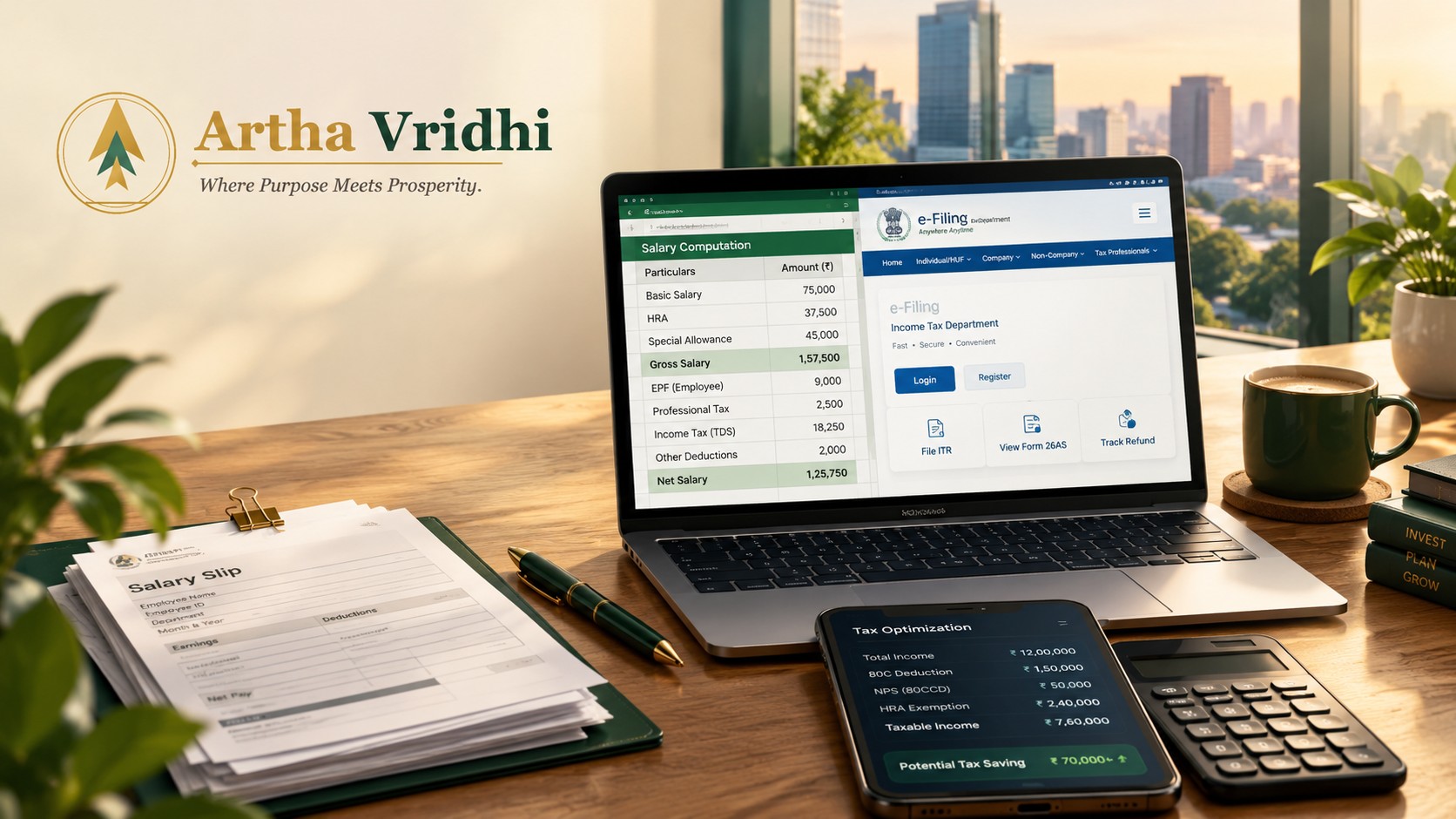
The H2 Mid-Year Salaried Tax Playbook: 5 Moves to Save TDS Before March 2027
If you opened your September or October payslip and noticed a sudden, unexplained jump in your Tax Deducted at Source (TDS), you are not alone.
Every year, as corporate India crosses the halfway mark of the financial year on September 30, payroll and HR departments across Bengaluru, Mumbai, and Gurgaon shift gears. In the first half (April to September), companies generally calculate TDS based on provisional investment declarations or default slabs. But in the second half (October to March), employers begin demanding proof of investments and recalibrating actual deductions.
If you have procrastinated on your tax planning, the unpaid tax liability for the entire financial year gets compressed into your remaining 5 or 6 salary cycles. The result? A painful, sudden reduction in your monthly in-hand cash flow.
In this playbook, we break down why your TDS spikes in October, compare the Old vs. New Tax Regimes, and share 5 actionable moves you can execute this week to protect your take-home pay before March 2027.
Why TDS Spikes in October: The Mechanics of Payroll Taxation
Under Section 192 of the Income Tax Act, employers are legally required to estimate an employee’s total annual income and deduct income tax equally across 12 monthly paychecks.
However, mathematical distortion occurs when:
- Unsubmitted Declarations: You joined a new company or forgot to submit initial investment declarations in April, leading payroll to assume zero deductions.
- Variable Pay & Bonuses: Performance bonuses or annual appraisals disbursed in Q2 or Q3 push you into higher tax brackets.
- The Compression Effect: If your total annual tax liability is ₹2,40,000, you should pay ₹20,000 per month. But if only ₹10,000 was deducted monthly from April to September (totaling ₹60,000), the remaining ₹1,80,000 must now be clawed back over the remaining 6 months. Your monthly TDS jumps from ₹10,000 to ₹30,000 starting in October.
Old vs. New Tax Regime: The Mid-Year Breakeven Analysis
Since the New Tax Regime is the default regime in India, every salaried professional must evaluate whether switching to (or remaining in) the Old Regime makes financial sense for FY 2026-27.
The decision comes down to your Total Eligible Deductions:
| Tax Component | New Tax Regime (Default) | Old Tax Regime (Optional) |
|---|---|---|
| Standard Deduction | ₹75,000 | ₹50,000 |
| Section 80C (EPF, PPF, ELSS, Insurance) | Not Allowed (₹0) | Allowed up to ₹1,50,000 |
| Section 80D (Health Insurance) | Not Allowed (₹0) | Allowed up to ₹25,000 – ₹1,00,000 |
| House Rent Allowance (HRA) | Not Allowed (₹0) | Fully Exempt based on formula |
| Home Loan Interest (Section 24b) | Not Allowed on self-occupied | Allowed up to ₹2,00,000 |
| Employer NPS (Section 80CCD(2)) | Allowed (up to 10% or 14% of Basic) | Allowed (up to 10% or 14% of Basic) |
| Tax Slabs & Rates | Lower, progressive tax brackets | Steeper brackets (30% above ₹10 Lakhs) |
| Breakeven Threshold | If total deductions are below ₹3.75 Lakhs | If total deductions exceed ₹3.75 – ₹4.25 Lakhs |
The Strategic Rule of Thumb: If you live in rented accommodation with substantial HRA claims, pay home loan interest on a self-occupied property, and maximize 80C/80D, the Old Regime can save you substantial tax. If you do not have heavy rent or home loan deductions, the New Tax Regime almost always delivers higher take-home pay with zero paperwork friction.
5 Practical Steps to Optimize Your Taxes in H2
Do not wait until the chaotic month of February to sort your taxes. Execute these 5 steps now:
1. Request Employer NPS Restructuring Under Section 80CCD(2)
This is one of the most powerful, under-utilized corporate tax benefits in India. Under Section 80CCD(2), your employer can deposit up to 10% of your Basic Salary directly into your National Pension System (NPS) Tier-1 account.
- Why it matters: This contribution is deducted from your gross taxable salary before TDS is computed. Crucially, it is available under BOTH the Old and New Tax Regimes.
- For an employee with a Basic Salary of ₹12 Lakhs annually, allocating 10% (₹1,20,000) into corporate NPS saves over ₹36,000 in annual tax at the 30% slab rate.
2. Audit Your Form 26AS and AIS on the E-Filing Portal
Log into your account on incometax.gov.in and examine your Annual Information Statement (AIS) and Taxpayer Information Summary (TIS). Verify:
- Are your fixed deposit interest, dividend payouts, and share/mutual fund transactions correctly reflected?
- Are there duplicate TDS entries or missed credits from a previous employer earlier in this fiscal year? Addressing discrepancies now prevents mismatch notices during return filing.
3. Submit Valid Rent Receipts and Landlord PAN Early
If opting for the Old Regime and claiming HRA exceeding ₹1,00,000 annually, your payroll department mandates the landlord’s PAN. Obtain digitally signed rent receipts, a formal rental agreement, and your landlord’s PAN today. If your landlord does not have a PAN, collect a signed Form 60 declaration to avoid HRA claim rejection.
4. Switch from Lump-Sum March Investments to a 6-Month SIP
Every March, millions of salaried employees frantically scramble to dump ₹1,50,000 into insurance endowments or tax-saving ELSS mutual funds to exhaust Section 80C. Instead of draining your bank balance at year-end, divide your remaining 80C gap into 6 equal monthly SIPs running from October to March in a diversified ELSS fund. You eliminate last-minute liquidity crises and benefit from rupee cost averaging.
5. Consolidate Income from Previous Employers
If you changed jobs between April 2026 and September 2026, ensure your current employer is aware of your previous salary. Fill out Form 12B and submit it to your current HR team. If both employers provide separate standard deductions and lower-bracket benefits, you will face a nasty tax shock and interest penalties under Sections 234B/234C when filing returns in July.
Frequently Asked Questions
Can I switch between the Old and New Tax Regime every year?
Yes, for salaried individuals having income only from salaries, house property, and capital gains (with no business or professional income), you have the freedom to choose whichever regime is more beneficial every single year at the time of filing your ITR.
Is Employer NPS under Section 80CCD(2) locked in until retirement?
Yes, contributions under Section 80CCD(2) go into the NPS Tier-1 account, which is locked until age 60 (with specific partial withdrawal allowances for medical emergencies, child education, or home purchase after 3 years). However, at maturity, 60% of the corpus can be withdrawn completely tax-free.
What happens if I fail to submit investment proofs to my company on time?
If you miss your company’s January/February proof deadline, your employer will deduct full TDS based on the assumption that you made no investments. However, you can still claim all eligible deductions when you file your formal Income Tax Return (ITR) in July and receive a tax refund directly into your bank account.
Talk to Artha Vridhi
Artha Vridhi assists salaried professionals in Bengaluru in structuring smart financial plans, aligning tax optimization with long-term mutual fund wealth creation. If you need help reviewing your salary structure, investment proof strategy, or setting up goal-aligned SIPs, connect with us on WhatsApp or visit www.arthavridhi.com.
Artha Vridhi · Where Purpose Meets Prosperity.
Saikat Rakshit, AMFI-registered Mutual Fund Distributor (ARN-362803), Bengaluru.
This article is for educational purposes only and does not constitute formal legal or tax advisory. Tax laws in India are subject to amendments and individual circumstances vary. Consult a qualified Chartered Accountant (CA) or tax professional for personalized tax advice.
Mutual fund investments are subject to market risks. Please read all scheme-related documents carefully before investing.